
In this article, I will guide you through installing Airflow and setting up HA for it. The environment used is virtualbox virtual machines.
Create 2 virtual machines with fixed addresses, add user and grant ssh access from host
1
2
3
4
5
6
7
8
9
10
11
12
13
14
15
16
17
18
19
20
21
22
23
24
25
26
27
28
29
30
31
VAGRANT_COMMAND = ARGV[0]

Vagrant.configure("2") do |config|

    if VAGRANT_COMMAND == "ssh"
      config.ssh.username = 'vagrant'
    end
    config.vm.box = "ubuntu/bionic64" # Choose the box you want to use

    # Initialize first virtual machine
    config.vm.define "machine1" do |machine1|
    machine1.vm.network "private_network", ip: "192.168.56.2"
    machine1.vm.provider "virtualbox" do |vb|
          vb.memory = "2048" # 2GB RAM
          vb.cpus = 1       # 1 core CPU
        end

    machine1.vm.provision "shell", inline: <<-SHELL
          adduser airflow
          sudo su - airflow -c $'\
          whoami && \
          mkdir .ssh && \
          echo "ssh-rsa xxxx" > .ssh/authorized_keys && \
          chmod 700 .ssh && \
          chmod 600 .ssh/authorized_keys && \
          file_path=".ssh/authorized_keys" && \
          echo "cat file $file_path after make change" && \
          cat $file_path '
        SHELL
    end
end
Concepts
- Allows building flow of tasks
- Provides convenient UI for monitoring and centralized task management
- Limitations: not used for transferring large data between tasks. Not used with infinite tasks (like streaming)
Airflow Components
scheduler
executor -> worker
executor
Types of executors:
- local: local executor, sequential executor
- remote: celery executor, kubernetes executor
Should use celery executor because it can scale the number of workers through celery backend (rabbitMQ, redis). The executor is like a way for tasks to be handed from scheduler to worker (stands between scheduling place and task execution place)

Additionally: metadata db, dag dir, web server
Install Airflow
Install airflow from pip
1
2
3
4
5
6
7
8
9
10
11
12
13
14
15
16
17
18
sudo apt update
sudo apt install python3-pip -y

export AIRFLOW_HOME=~/airflow

AIRFLOW_VERSION=2.5.1
PYTHON_VERSION="$(python3 --version | cut -d " " -f 2 | cut -d "." -f 1-2)"
CONSTRAINT_URL="https://raw.githubusercontent.com/apache/airflow/constraints-${AIRFLOW_VERSION}/constraints-${PYTHON_VERSION}.txt"

echo $CONSTRAINT_URL

python3 -m pip install --upgrade pip (when setup tools error)
pip3 install "apache-airflow==${AIRFLOW_VERSION}" --constraint "${CONSTRAINT_URL}"

or simpler (but more errors :v)
python3.8 -m pip install --upgrade pip
python3.8 -m pip install apache-airflow==2.5.1
Initialize db
1
2
3
4
5
6
7
8
9
10
11
12
13
14
15
16
17
18

python3 -m airflow db init

# error ModuleNotFoundError: No module named 'apt_pkg'
sudo apt-get install python-apt

# now creates AIRFLOW_HOME directory
# default sql_alchemy_conn = sqlite:////home/airflow/airflow2/airflow.db

# change db to mysql then run db init again
CREATE DATABASE airflow_db CHARACTER SET utf8mb4 COLLATE utf8mb4_unicode_ci;
CREATE USER 'airflow_user' IDENTIFIED BY 'airflow_pass';
GRANT ALL PRIVILEGES ON airflow_db.* TO 'airflow_user';
FLUSH PRIVILEGES;

vi airflow/airflow.cfg
mysql+mysqldb://airflow_db:airflow_pass@192.168.56.1:3306/airflow_db  # this error
mysql+mysqlconnector://airflow_user:airflow_pass@192.168.56.1:3306/airflow_db
Run components webserver, scheduler
1
2
3
4
5
6
7
8
9
10
11
12
13
14
15
16
airflow users create \
    --username admin \
    --firstname Peter \
    --lastname Parker \
    --role Admin \
    --email spiderman@superhero.org

# then enter password

airflow webserver --port 8080 [-D, -h]

airflow scheduler [-D, -h]

# kill daemon
kill $(ps -ef | grep "gunicorn" | awk '{print $2}')
Install rabitmq
1
2
3
4
5
6
7
8
sudo apt update && sudo apt upgrade -y
sudo apt install rabbitmq-server -y
sudo systemctl enable rabbitmq-server
sudo systemctl start rabbitmq-server
sudo systemctl status rabbitmq-server
sudo rabbitmq-plugins enable rabbitmq_management
sudo rabbitmqctl add_user airflow airflow
sudo rabbitmqctl set_user_tags airflow administrator
Switch to CeleryExecutor
However, running it that way also has errors The scheduler does not appear to be running. Last heartbeat was received 14 minutes ago.
Switch to a standard different executor to see
1
executor = CeleryExecutor
Change celery broker + result backend
1
2
3
4
5
6
7
8
broker_url = redis://redis:6379/0
broker_url = amqp://airflow:airflow@192.168.56.10:5672/
result_backend = db+mysql://airflow_user:airflow_pass@192.168.56.1:3306/airflow_db

# set mysql+mysqlconnector error
# install additional celery if not available
pip install 'apache-airflow[celery]'
Run flower to view job
Monitoring Tasks
1
2
3
4
5
6
7
8
9
10
11
12
13
14
15
16
17
# flower
# Celery Flower is a sweet UI for Celery. Airflow has a shortcut to start
# it ``airflow celery flower``. This defines the IP that Celery Flower runs on
flower_host = 0.0.0.0

# The root URL for Flower
# Example: flower_url_prefix = /flower
flower_url_prefix = /flower

# This defines the port that Celery Flower runs on
flower_port = 5556

# error amqp.exceptions.NotAllowed: Connection.open: (530) NOT_ALLOWED - access to vhost '/' refused for user 'airflow'

sudo rabbitmqctl list_permissions -p /
sudo rabbitmqctl set_permissions -p "/" "airflow" ".*" ".*" ".*"
Various errors because haven’t installed
1
2
3
sudo apt-get install python3.8-dev
# Make sure each installation must follow python3-pip python3.10-dev python3.10-venv set
Jobs when run will be pushed to queue

On airflow ui will see task queued but not running
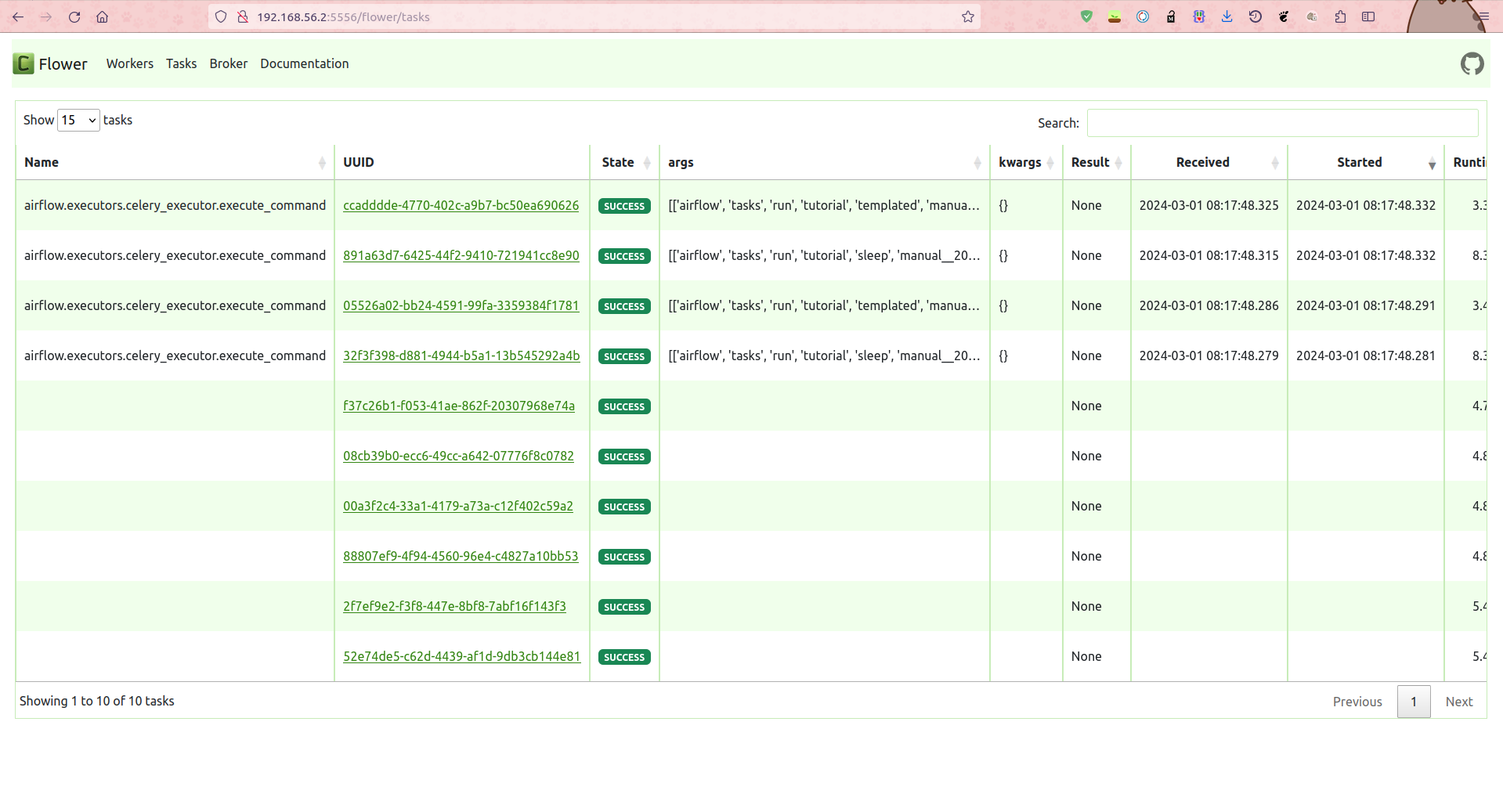
However, flower doesn’t display task because I haven’t started worker
Run worker
1
2
3
4
airflow celery worker

# note: worker can be attached to 1 queue
airflow celery worker -q spark,quark
HA Model
Web server. Run on the 2nd machine with identical config: still works, proves that just running 2 machines simultaneously with HA ip works. Proves webserver only needs db? (synchronize through db)
Scheduler. Run on the 2nd machine, everything is still normal on machine 1 (flower, rabitMQ, worker on machine 1 still receive)
Web server, Scheduler on 2nd machine
1
2
3
4
5
6
ImportError: No module named 'mysql'
pip install mysql-connector-python-rf

sqlalchemy.exc.NotSupportedError: (mysql.connector.errors.NotSupportedError) Authentication plugin 'caching_sha2_password' is not supported
pip install mysql-connector-python
1
2
3
4
5
6
7
8
9
10
ModuleNotFoundError: No module named 'MySQLdb'
pip install mysqlclient
# still error
sudo apt-get install python3.8-dev
# still error
sudo apt-get install python3-dev default-libmysqlclient-dev build-essential pkg-config

# install additional celery if not available
pip install 'apache-airflow[celery]'
Message queue, mysql have their own HA methods
Because Scheduler when 2 machines run jobs will be x2, so must have only 1 machine running -> need HA Scheduler
1
2
3
4
5
6
7
8
pip3 install git+https://github.com/teamclairvoyant/airflow-scheduler-failover-controller.git@v1.0.8
scheduler_failover_controller init  # append HA config to airflow.cfg
scheduler_failover_controller start

# run, stop commands are in config file
# note config scheduler_nodes_in_cluster List of potential nodes that can act as Schedulers (Comma Separated List)
# switch log to debug will see scheduler_failover_controller check by
Running Command: ps -eaf | grep 'airflow scheduler'
error cannot run
1
2
3
4
5
6
7
8
9
10
11
12
13

in configuration.py:


def get_sql_alchemy_conn(self):
        return self.get_config("core", "SQL_ALCHEMY_CONN")


but maybe airflow.cfg, the section is [database]. so that engine can be null

add sql_alchemy_conn both [database], [core] in airflow.cfg can fix this issue

https://github.com/teamclairvoyant/airflow-scheduler-failover-controller/issues/43
Notes
- xcom (cross-communications) to pass information between tasks in dag
- get_pty=True to be able to kill task on ui
- do_xcom_push=False to avoid case where xcom saves output> 65kb leading to task fail (use print or return function)